About
Strategy for a World That Refuses to Stand Still
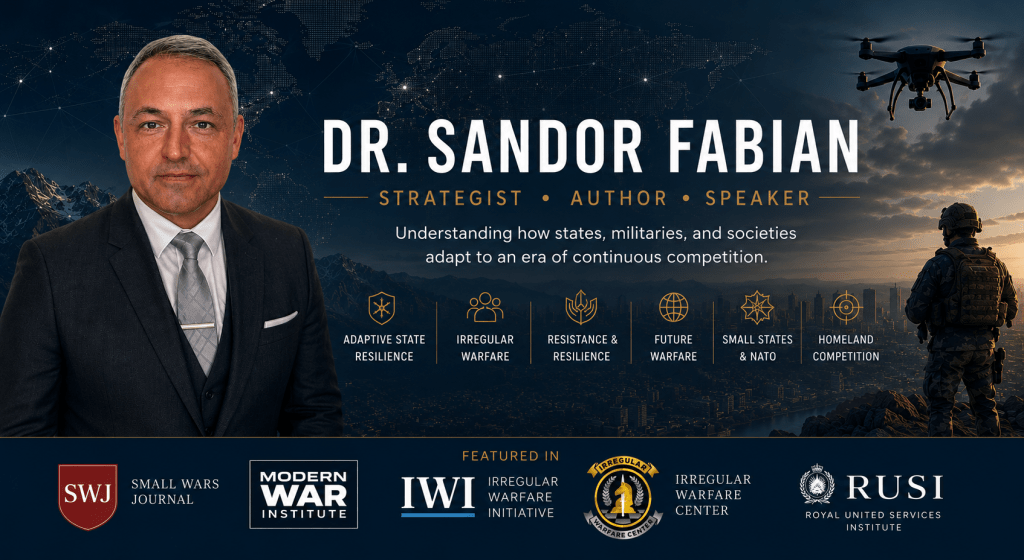
Dr. Sandor Fabian is a strategist, author, researcher, and educator specializing in irregular warfare, resistance, adaptive state resilience, small-state defense, and the changing character of warfare.
At the center of his work is a fundamental question: Why do some states and organizations adapt successfully to strategic disruption while others—with greater resources, technology, and conventional power—fail to do so?
His research challenges traditional assumptions about national power and military effectiveness. Rather than viewing security primarily through the size of armed forces, economic resources, or technological superiority, Fabian examines the increasingly important role of adaptation, institutional learning, societal resilience, organizational agility, and resistance capacity in determining strategic outcomes.
He is the developer of Adaptive State Resilience Strategy (ASRS), a framework that reconceptualizes resilience as more than the ability to withstand disruption and recover from crisis. ASRS focuses on developing the capacity of states to anticipate, absorb, adapt, recover, and ultimately transform in response to persistent competition and strategic change.
Fabian’s broader scholarship explores irregular warfare and resistance, the challenges facing NATO and small states, multidomain operations, emerging military technologies, homeland competition, and the implications of drones and other technologies for the future of warfare. His work frequently examines how conventionally weaker actors can create strategic advantage against materially superior competitors.
His research and analysis have appeared in leading national-security and defense outlets, including the Modern War Institute, Small Wars Journal, Irregular Warfare Initiative, Irregular Warfare Center, and Royal United Services Institute (RUSI).
Across his research, teaching, writing, and public speaking, Fabian seeks to connect strategic theory with practical problems confronting governments, militaries, and societies.
Adaptive State Resilience • Irregular Warfare • Resistance • Future Warfare • Small-State Defense • NATO • Homeland Competition • Strategic Adaptation.

